
The Biographical Wall
THE LANGUAGE OF ART
After moving to Austria, I began going regularly to art exhibitions in Munich and Vienna. I did not yet speak German, yet I approached each new place through the language of art — as I still do whenever I travel. Exhibitions are always at the top of my list. I gravitate toward modern and contemporary art for its variety and for the way it allows me to discover the world through other artists’ eyes.
Over time, I began to notice a recurring feature in solo art exhibitions in Munich and Vienna: the biographical wall placed at the entrance of the exhibition. I had not really encountered it in this form elsewhere — not in the UK, for example, despite its dense international art scene. In Munich and Vienna, however, it appears consistently, in smaller shows as well as in major retrospectives.
This wall typically contains a detailed chronology: parents, studies, formative influences, exhibitions, awards, relocations, key life events — often from birth to the present day. I generally appreciate context. There are artists whose work is inseparable from their lives; with someone like Pablo Picasso, for example, knowing his relationships and personal history inevitably deepens one’s reading of the portraits. Yet the scale and positioning of the biographical wall — prominently placed at the very entrance of the exhibition, before encountering a single artwork — left me unsettled.
Most of the time I would photograph it, telling myself I would read it later. I almost never did. I would move on to the works themselves. At the same time, I noticed that the curatorial texts accompanying contemporary pieces were often sparse and abstract, sometimes more confusing than clarifying, even to someone comfortable with theoretical language. The biographical wall began to feel less like context and more like a precondition — as if rationalisation had to precede experience. As if the artist’s presence within the institution had to be justified through a documented and defensible record before the viewer could surrender to the image.
LITERATURE AS A CULTURAL KEY
For a long time, I could not quite articulate why this structure felt so distinct, or why I encountered it repeatedly in Munich and Austria. Only after reading Thomas Mann — especially Death in Venice and Gladius Dei — did I begin to find conceptual language for this intuition.
Mann’s writing offered me an unexpected window into German culture, which had initially felt somewhat opaque to me. In these novellas, he stages a tension between literature — associated with reason, morality, intellectual discipline — and visual art, which is cast as the realm of sensual beauty. In Gladius Dei, Munich becomes the setting for Mann’s sharp depiction of how art is publicly framed and subjected to moral scrutiny. Within this world, art is not simply enjoyed but carefully examined and sometimes mistrusted.
In Death in Venice, beauty overwhelms the protagonist, an accomplished writer who is progressively consumed by his aesthetic obsession. Beauty triggers regression into myth and primal symbolism, and with it a suspension of intellectual control. I remember reading it with a sense of distance, almost resistance. Mann’s language is flawless, but it does not invite immersion; instead, it observes and analyses the very state it describes. The artist-intellectual is immobilised and overwhelmed by aesthetic perfection, entering a gradual dissolution that ultimately leads to his death. There is a palpable tension between intellect and beauty, between discipline and desire.
Munich itself becomes symbolically charged in both novellas, standing as a threshold city — between North and South Germany, and symbolically between German reason and Italian sensuous beauty. It is the home of the protagonist in Death in Venice, the setting of Gladius Dei, and the city where Mann himself relocated from Lübeck. The Mediterranean influence is visible in places like Odeonsplatz at the southern end of Ludwigstraße, with its Italian-inspired architecture. Mann even began an essay titled Geist und Kunst (“Spirit and Art”), which he never finished, revealing how central this tension was to his thinking.
Through this cultural key, the biographical wall began to make more sense to me. It seemed part of a longer tradition of caution toward the image — a need to frame and intellectually contain the visual. Even if contemporary German society is far removed from the anxieties of Mann’s time, there appears to be a cultural afterimage: visual art is rarely allowed to stand on its own terms. It is accompanied, anchored, stabilised — often before it has had the chance to establish its own relationship with the viewer. The concern, at least for me, is not interpretation itself, which is the purpose of curation. It’s the weight and priority given to contextual information that precedes the encounter and does not always seem directly related to the experience of the work.
BEAUTY AS A THRESHOLD
There are, of course, many different views of beauty in art. Recently I encountered one that felt more in tune with my own sense of beauty. The Romanian conductor Sergiu Celibidache, whose life was recently the subject of the film The Yellow Tie, described beauty as a door to transcendence — something that draws us in, but is not the final destination.
I feel closer to this understanding — that beauty does not inevitably dissolve intellect but can just as well expand and transform it. The difference may lie less in the image itself and more in how we encounter it.
When I now stand in front of a biographical wall, I no longer see it merely as excess information. I see it as part of a cultural gesture — an attempt to ensure that experience remains bound to narrative and the visual does not detach from history. Whether that bond enriches or restricts the encounter probably depends on the viewer. For my part, I still prefer to enter an exhibition through the image first, and only later — perhaps — return to the chronology. I have written elsewhere about a different dynamic between artwork and visitor in immersive exhibitions, particularly during my visit to the Venice Biennale.
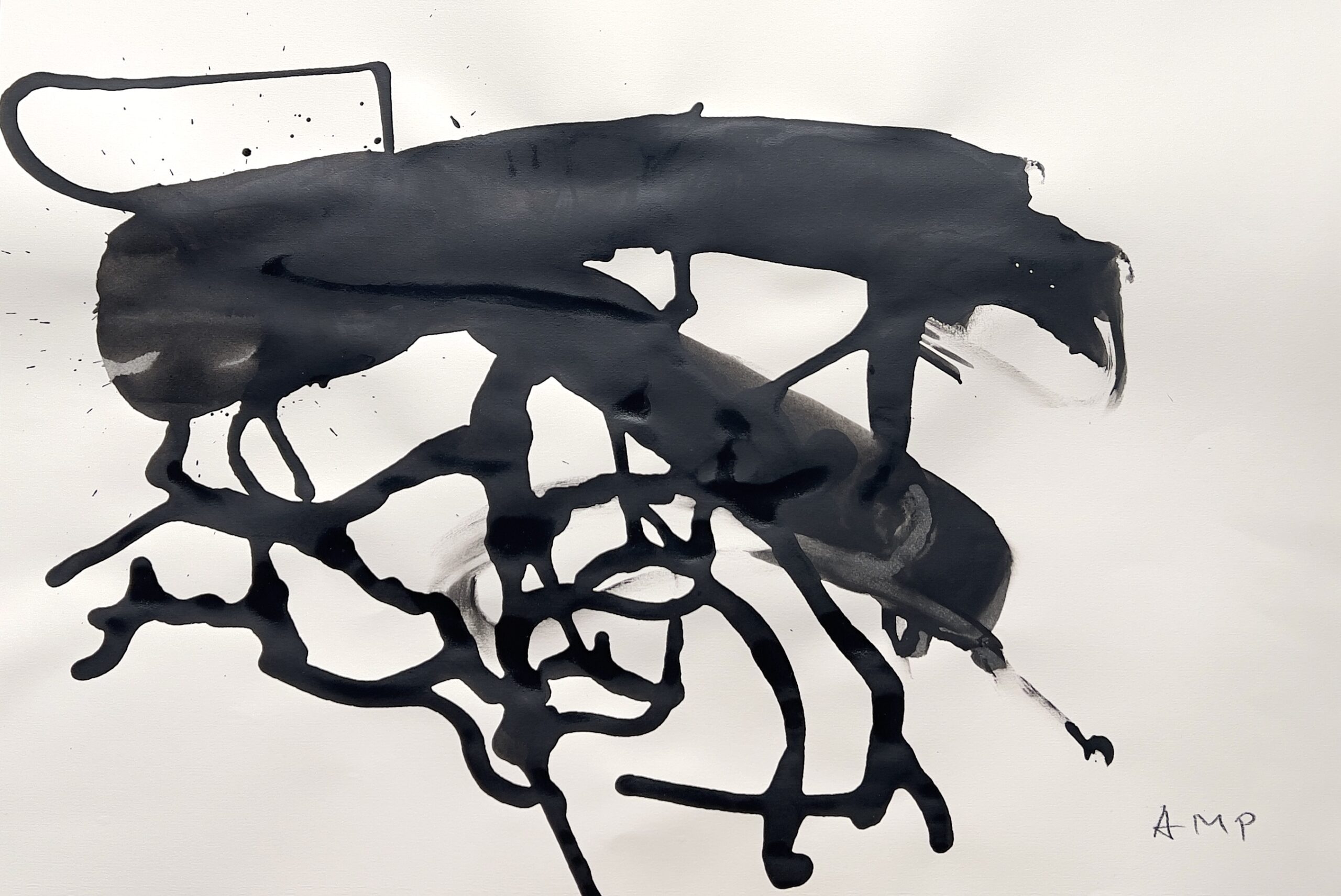
Featured image: Untitled — ink on paper, Ana M Pop, Kufstein, February 2026


Leave a Reply